Pages

Computer technology: How To Submit Blogger Sitemap To Google Webmaster ...

Posted on Tuesday, March 15, 2016 by Unknown

Computer technology: How To Submit Blogger Sitemap To Google Webmaster ...: To be successful in your blogging career you must have to generate decent organic traffic to your blog. By the term “ organic traffic ” I...

Computer technology: How to Manage Your Android Smartphone From Desktop...

Posted on by Unknown

Computer technology: How to Manage Your Android Smartphone From Desktop...: No matter how advanced your smartphone is, multi-tasking on it is a living nightmare. We are limited by the small screen on a smart...

Computer technology: 10 Tips To Tighten Security On Your Android Device...

Posted on by Unknown

Computer technology: 10 Tips To Tighten Security On Your Android Device...: Smartphones have come to define us by being the portal to our online identity and as such should be treated with care and secured agains...

Computer technology: how to Create your own time-saving keyboard short...

Posted on by Unknown

Computer technology: how to Create your own time-saving keyboard short...: Tired of repeatedly tapping your street address, your job title, or common phrases like “on my way” or “you there?” on your iPhone or And...

Computer technology: 10 Useful Android Tips And Tricks for you

Posted on by Unknown

Computer technology: 10 Useful Android Tips And Tricks for you: Whether you are new to Android and eager to try out every available option you see on the screen, or familiar with the system, including ...

Computer technology: How To Set A Different Wallpaper For Multiple Moni...

Posted on by Unknown

Computer technology: How To Set A Different Wallpaper For Multiple Moni...: Windows 10 has greatly restricted how much users can personalize the appearance of the OS. Themes aren’t what they used to be and it was o...

Computer technology: How To Get A Dark Start Menu & Taskbar With Colore...

Posted on by Unknown

Computer technology: How To Get A Dark Start Menu & Taskbar With Colore...: Windows 10 takes it upon itself to ensure you have a nice color scheme on your system. You can choose the color of the title bars, taskbar...

Computer technology: How To Get A Dark Start Menu

Posted on by Unknown

Computer technology: How To Get A Dark Start Menu: Windows 10 takes it upon itself to ensure you have a nice color scheme on your system. You can choose the color of the title bars, taskbar...

Computer technology: 10 Useful Android Tips And Tricks for you

Posted on Thursday, March 10, 2016 by Unknown

Computer technology: 10 Useful Android Tips And Tricks for you: Whether you are new to Android and eager to try out every available option you see on the screen, or familiar with the system, including ...

Basic network troubleshooting

Posted on Saturday, September 27, 2014 by Unknown


Because of the variety of network configurations, operating systems, setup, etc. not all of the below information may apply to your network or operating system.
Note: We cannot assist you with network problems due to an unknown passwords or unknown ISP settings. Since we have no method of verifying or determining this information.

Adapter resources

Device Manager network adaptersVerify that the network adapter is properly installed and detected by the computer with no conflicts. If you're using Microsoft Windows check in Device Manager and verify there are no errors and "Network adapters" is present with each network adapter installed in the computer listed, similar to the example on the right.
  • How do I get into Windows Device Manager?
  • Identifying problems in Windows Device Manager.
If conflicts exist or the network adapter is being detected as an Other device. The network card has not been properly installed in the computer. Try letting Windows re-detect and install the Network card by removing the network adapter and any other conflict devices from Device Manager and then rebooting the computer. If Windows re-detects the card but does not find the drivers, download the network adapter drivers from the computer manufacturer or the network card manufacturer.
  • How do I remove a device in Windows Device Manager?
  • Listing of network drivers and network card manufacturers.

Verify connections

Wired Network
Ethernet LAN portIf this is a wired network, verify that the network cable is properly connected and make sure the LEDs next to the network jack are properly illuminated. For example, a network card with a solid green LED or light usually indicates that the card is either connected or receiving a signal. If the green light is flashing, this is an indication of data being sent or received. In the picture is an example of LAN port with two LED indicators next to the RJ-45 port. With this port, one LED will light up if connected properly and the other will flash when transmitting data.
If there are no lights or the lights are orange or red the card may be bad, not connected properly, or that the card is not receiving a signal from the network. If you are on a small or local network and have the capability of checking a hub, switch, or router verify that the cables are properly connected and that it has power. If after checking the connections the LED indicators appear bad, the network adapter, port, or cable may be defective.
Wireless Network
Wi-Fi button on laptopIf you're using a laptop with a wireless network make sure if the laptop has a Wi-Fi button that it is turned on. Many laptops have a Wi-Fi button that allows the wireless network to be turned on and off. In the picture is an example of a Wi-Fi button that is currently enabled.
If the Wi-Fi button is turned on, make sure you're connecting to the correct Wi-Fi hotspot by right-clicking on the Network icon in the Windows notification area and clicking "Connect to a network". Usually, the network with the strongest connection (the most bars) will be your wireless router.
Finally, when connecting to most wireless networks you need to enter the proper SSID (password) in order to connect to the network. If the incorrect SSID has been entered you cannot access the network.

Adapter functionality

Verify that the network card is capable of pinging itself by using the ping command. Windows users can ping the computer from a Windows command line. Unix and Linux users can ping from the shell.
To ping the card or the localhost, type either
ping 127.0.0.1
or
ping localhost
Doing either of the above commands should get replies from the network card. If you receive an error or if the transmission fails the network card is not physically installed into the computer correctly, has the incorrect drivers, or that the card is bad.

Connect to the router

If all of the above steps have been checked and your network has a router, make sure the computer can connect to the router by performing the below commands.
Determine the routers address
Using the ipconfig command (or ifconfig command for Linux) determine the router's address by looking at the Gateway address. Below are the steps for Microsoft Windows users, Linux users can substitute ipconfig for ifconfig.
  1. Open the Windows command line.
  2. From the command prompt type ipconfig and press enter. This command should give you an output similar to the example below.
Ethernet adapter Local Area Connection:
Connection-specific DNS Suffix . : computerhope.com.
IP Address. . . . . . . . . . . . : 192.168.1.103
Subnet Mask . . . . . . . . . . . : 255.255.255.0
Default Gateway . . . . . . . . . : 192.168.1.1
The Default Gateway is the address of your router. Most home routers have a gateway address that starts with 192.168 like the address shown above. Assuming your gateway address is 192.168.1.1 attempt to ping the router to see if it can send and receive information by running the below command.
ping 192.168.1.1
If you get replies back from the router, the connection between your router and computer are good, and you can skip to the next step.
If you do not receive any replies back from the router either the router is not setup properly or your connection between the router and the computer are not correct. Reset your router to make sure it is not a problem with your router by following the steps below.
  1. Turn off the power to the computer and leave it off.
  2. Unplug the power to your router and cable modem or DSL modem.
  3. Leave the power cables disconnected for 10-15 seconds and then plug in your modem and then your router again.
  4. Finally, turn on your computer again and repeat this step to see if you can ping your router.
If you're using a wireless network and have followed all the above steps and still are unable to ping the router try turning off the computer again and connect the computer to the router using a cable instead of trying to connect using wireless. If a wire does also not work connect the manufacturer of the router for additional support or replacement.

Firewall

If your computer network utilizes a firewall, make sure all required ports required are open, especially port 80, which is the HTTP port. If possible, disable the firewall software program or disconnect the computer from the firewall to make sure it is not causing the network problems.

Internet is not working

If you're able to ping the router, but are still unable to connect to the Internet, either your router is improperly configured or the ISP is having issues.
Note: Some ISPs such as Comcast require special software be installed. Make sure any software included with your Modem or other hardware has been installed on at least one computer if you are setting up a new Internet connection.
If your Internet has been working but recently stopped working, give it a few minutes to make sure it is not a temporary outage. If after waiting a few minutes, you still have problems and you have not disconnected the power to your router and modem already follow the steps below.
  1. Turn off the power to the computer and leave it off.
  2. Unplug the power to your router and cable modem or DSL modem.
  3. Leave the power cables disconnected for 10-15 seconds and then plug in your modem and then your router again.
  4. Finally, turn on your computer again and repeat this step to see if you can ping your router.
If after following the above steps the Internet is still not working, open the Windows command line and run the below command.
ping google.com
Running the above command should get a reply from Google. If you get a reply, this is an indication that the Internet is working, but you may be encountering a problem with the Internet browser you are using to browse the Internet. Try an alternative browser such as Firefox or Chrome.
If you're getting no reply from Google, your router or modem is not reaching the Internet. If you have a router, make sure your router has DHCP enabled and that the WAN or Gateway address is the proper ISP address.
Finally, after verifying all of the above settings if your Internet is still not working we suggest contacting the ISP to make sure it is not a problem on their end and to assist you further with any special configurations that may not be mentioned in this document.

Additional troubleshooting

Another method of determining network issues is to use the tracert command if you are a Windows user or the traceroute command if you are a Linux or Unix variant user. This command gives you an overview of each of the devices (routers) a packet travels (hops) over a network and can give you an idea of where a problem exists in your network or outside of your network.
To use this command you must be at the command line and type one of the below commands depending on your operating system.
tracert google.com
or
traceroute google.com
If run successfully you should begin to see each hop between the computer and network devices. When the connection fails, determine what device is causing the issue by reviewing the traceroute listing.

Missing or lost sound in Windows

Posted on by Unknown


SoundVerify software volume control settings

First verify you see a small sound icon Windows XP sound icon or Windows Vista sound icon in the Windows notification area (bottom right-hand corner of your screen). If this icon is missing, follow the steps below. If you see this icon skip to next section.
Windows XP
  1. Open the Control panel
  2. Open the "Sounds and Audio Devices" icon.
  3. Verify the "Place volume icon in the taskbar" checkbox is checked. If this option is not available or is grayed out, skip to the next section of this document.
  4. If you were able to check this box, click ok and close out of this window and the Control Panel.
  5. Double-click the sound icon in the Systray and verify that all the sound volumes are mid-way or higher.
Windows 2000
  1. Open the Control panel
  2. Open the "Sounds and Multimedia" icon.
  3. Verify the "Show volume control on the taskbar" checkbox is checked. If this option is not available or is grayed out, skip to the next section of this document.
  4. If you were able to check this box, click ok and close out of this window and the Control Panel.
  5. Double-click the sound icon in the Systray and verify that all the sound volumes are mid-way or higher.
Windows 95, 98, or ME
  1. Open the Control panel
  2. Open the "Multimedia" icon.
  3. Check the checkbox for "Show volume control on the taskbar." If this section is grayed out, change the Playback "Preferred device" by clicking the down arrow and changing to an alternate selection. If that is also grayed out, skip to the next section of this document.
  4. If you were able to check this box, click ok and close out of this window and the Control Panel.
  5. Double-click the sound icon in the Systray and verify that all the sound volumes are mid-way or higher.

Verify the installed driver settings

  1. Open the Windows Device Manager
  2. Verify there are no conflicts or errors listed anywhere in Device Manager. If conflicts exist skip down to conflicts section.
  3. Verify no "Other devices" are listed. If other devices are listed skip down to other devices section.
  4. Verify that your "Sound, video and game controllers" category is listed, if not skip down to the missing sound card section.
  5. If no conflicts or other devices are listed and your sound card is listed with no conflicts, skip to the next section.
Conflicts section
If conflicts exists with your sound card or other devices installed in your computer it is likely that either the drivers are not properly installed for that device or the sound card or other devices are conflicting. If you open the properties of the device that is conflicting and view the properties, additional details about the conflict can be found. Additional information about error codes as well as help with Device Manager can be found on our Device Manager section.
If you are unable to locate additional information about your issue or are unable to resolve the issue, follow the steps below.
  1. Under Sound, Video and game controllers highlight each device and press the delete key to remove the device.
  2. Reboot the computer.
  3. As the computer is booting the system will detect the sound card and any of it's devices and re-install those devices. If prompted for a location of drivers, try pointing it to your sound card CD or your Windows CD. If this does not work or is unable to locate the proper files, you need to get the latest sound drivers from your sound card manufacturer.
Other devices section
If Other devices are listed, these could be the sound card or another conflicting device. If any other devices are listed it is recommended you remove those devices, reboot the computer and let Windows redetect the devices.
If this does not work, determine what device is not being detected and resolve that issue first.
Missing sound card section.
If you are missing the "Sound, video and game controllers" category in Device Manager, it is likely that the sound card drivers are not installed properly, sound card has been disabled, sound card is bad, or no sound card is available in the computer. First, verify no conflicts or other devices are present in the Device Manager; if these are present it is likely they are the sound card or devices causing the sound card not to be detected. Second, verify that the computer has a sound card and that the sound card is enabled on the computer.
If this is an on-board sound card you can verify that it is enabled in CMOS setup.
If you have no adapters or cannot click the down arrow to select the correct adapter, close out of this Window. In Control Panel double-click the System icon, click the Device Manager tab within Device Manager and ensure there are no yellow ! or red X.
If you have either of these on any of your sound devices, remove everything under Sound Video game controllers and reboot the computer. If after rebooting the computer you still have the same conflicts, double-click on the conflicting device and refer to our Device Manager error code section giving you additional information on the error code you are experiencing.

Verify speaker connections

Verify the speakers settings and speakers are not at fault by running through computer speaker troubleshooting.

Sound card drivers

If you have followed the above recommendations and you are still unable to get the sound card to work, in Device Manager remove all sound video and game controllers and reboot the computer. This should cause Windows to reinstall all missing drivers and often can correct corrupt drivers. If this does not work after rebooting the computer download and install the latest sound card drivers from the computer or sound card manufacturer. A listing of sound card drivers can be found on our sound card driver page.

Defective hardware

Finally, if all of the above recommendations do not resolve your issue it is likely that either the sound card is physically bad or that the operating system is severely corrupt. We recommend you contact the manufacturer of the sound card or computer for a replacement or additional recommendations.

No display on the monitor

Posted on by Unknown


Tip: The following is monitor troubleshooting and not for users who get readable picture when it is first load but then gets distorted when opening Windows.

Monitor is not on

Make sure the monitor is on. If no power LED (green or orange light) is seen on the monitor display try pressing the power button until it comes on. If no light comes on after several attempts continue to below connections not connected properly.

Computer is asleep

If your computer monitor was on and you stepped away from the computer and upon returning it was black it's likely that the computer is asleep. Try moving your mouse, clicking the mouse buttons, or pressing any key (space bar) on the keyboard to wake it up.

Connections not connected properly

Computer VGA port and cableMake sure that you are connecting the monitor to the back of the computer in the 15-pin connector as shown to the right or older computer 9-pin connection.
Note: Newer computers may be using a DVI or HDMI cable for the monitor.
If the computer is properly plugged in, make sure it is getting power.
If you are not receiving power from a known working wall outlet and if the power cord is removable, replace it with the one connected to the computer and power on the monitor again. If the monitor still does not get power or it is not removable, it is recommended that the monitor be replaced or serviced at a local TV or computer repair shop.
If the monitor is receiving power, check the LED status light.
If the light is orange or flashing ensure that the monitor is not in a suspend mode by moving the mouse or pressing a key on the keyboard. If the computer does not get a display by moving the mouse or touching the keyboard, turn off the computer and monitor and reconnect the data cable from the back of the computer, and if removable, the back of the monitor. Turn the computer back on; if you still encounter the same issue, continue reading through the other possibilities.

Monitor settings are not correct

Verify the brightness and contrast is turned up or adjust the brightness and contrast. If adjusting the brightness or contrast has no affect on the monitor continue reading through the other possibilities.

No POST

Does the computer beep when it is powered on or does it appear that the computer has activity? If the computer does not beep or beeps abnormally the computer is experiencing a hardware issue or is exhibiting a No POST. Run through the POST troubleshooting steps to determine the failure.

Hardware Issue

If you have followed the above recommendations and are still encountering the same issue, it is likely that the computer may have either a bad video card or monitor. The best method of determining this is to do one or both of the following:
  • Disconnect your monitor and connect it to another computer. This can be a friend or family's computer or it can be taken to a service center.
  • Borrow a computer monitor and connect it to your computer. This will not harm the other computer monitor in any way.
If your monitor works on another computer it is safe to assume that the video card or potentially the motherboard within the computer is bad.

Windows error "Data or no disk loaded" with audio CD Bad or non audio CD is inserted

Posted on by Unknown


CDMake sure the CD you have currently in the computer is not bad or being misread by the computer by inserting another known good audio CD into the computer.
If another audio CD works it is likely either that the CD is dirty or may be an enhanced CD incompatible with the CD Audio player. Steps on properly cleaning a CD can be found on our cleaning page.

MCI CD audio driver not installed or is corrupt

If no audio CD is working in the computer but other CDs work fine, it is likely that the MCI CD audio driver is not installed or is corrupt on the computer.
  • CD-ROM not working in Windows 9x, 2000, or XP.
To reinstall or install the MCI CD audio drivers follow the steps below:
  1. Click Start, Settings, Control Panel
  2. Double-click on Multimedia
  3. Click the Advanced tab or Device tab.
  4. Double-click Media Control Devices.
  5. Double-click CD Audio Device (Media Control).
  6. If this device is present and no audio CDs are working, click remove on the general tab in CD Audio Device (Media Control) properties.
  7. Close out of all open Windows to get back to the Control panel
  8. In Control panel double-click Add New Hardware.
  9. Click Next, select No, click Next -- In the box listing the available hardware, select Sound Video and Game controllers and click Next.
  10. In the Manufacturers box select Microsoft MCI.
  11. In the Models box select CD Audio Device (Media Control).
  12. Click Next and Finish.
  13. Once Windows has completed the installation of the new device, reboot the computer.

What should I do when a computer freezes?

Posted on by Unknown


Frozen computer hard drive 

This document contains recommendations on what to do if the computer freezes or dead locks. If your computer has stopped responding, follow the steps below to attempt to get the computer to unfreeze.
Tip: If you are concerned about an important document that hasn't been saved, the program you are using may have an AutoSave feature, and you may be able to recover a recent version of the document after rebooting.
Note: If your program does not have an AutoSave feature or the ability to recover a recent version of a document, you may lose all unsaved work due to a freeze or dead lock. It is important to save your work often to minimize or prevent this possibility.

Give the computer some time

Wait. Give the computer a few minutes to process. Sometimes a computer may appear to be froze, but it is really just slow or busy processing a complex task.

Is the computer dead locked?

Computer keyboard num lock LEDSee if the computer can respond to anything by pressing the Caps Lock key on the keyboard and watching the Caps Lock led (light) to see if it turns off and on. If the computer can turn on and off Caps Lock, continue to the next step. If nothing happens, the computer is dead locked, and you must reboot the computer.
End Task the Not Responding program

If the Caps Lock can turn off and on, Windows is still working, but another program may not be responding and causing the computer to freeze. Press Ctrl + Alt + Del to open the Windows Task Manager. If the Task Manager can open, highlight the program not responding and choose End Task, which should unfreeze the computer.
Note: It could still take ten to twenty seconds for the unresponsive program to be terminated after you choose End Task.

Reboot a frozen computer

If none of the above steps helped, you must reboot the computer. To reboot a frozen computer, press and hold down the power button until the computer turns off. Once the computer is off, wait a few seconds, then turn the computer back on and let it start as normal.
Note: During the computer startup process, you may see a screen asking if you want to start the computer in Safe Mode or Start Windows Normally. Choose the Start Windows Normally option and see if Windows starts up correctly, without error.

Resolve Hardware or Device Driver issue

If after trying all of the above there may be defective hardware or a device driver is not working correctly. A defective hard drive, stick of RAM, video card, or other piece of hardware can cause a computer to freeze. A device driver can also cause a computer to freeze if it is out of date, conflicting with another driver, or just not working properly.
If you determine that a defective piece of hardware is causing the freezes, you should replace the hardware right away, to prevent further damage to the computer. If a device driver is at fault, you can try to download the latest driver from the manufacturer's website and install it before the computer freezes, or use another computer to download the driver and try installing the driver on your computer.
If you are unable to install the latest driver before the computer freezes, another option is to start the computer in Safe Mode. Once in Safe Mode, you can access Device Manager and uninstall the hardware device corresponding to the device driver that is not working correctly. Then, restart the computer and load into Windows normally. Windows should detect the hardware that you uninstalled and try to reinstall the device driver. This process may be enough to fix the issue and stop further freezes from occurring. You can also try installing the latest driver at this point, to make sure your computer is up-to-date for that device driver.
You can also try accessing the computer BIOS and disabling any hardware that is working properly, to see if that stops the freezes from occurring. However, you should still replace that hardware, as you may not be able to use your computer fully if the hardware remains disabled.

Take PC to Repair Shop

If none of the above options work or are possible to try, we recommend you take your computer to a computer repair shop and allow a computer technician to diagnose and fix the problem.

Not a valid Win32 application

Posted on by Unknown


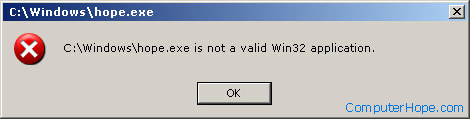
Not a valid Win32 application Windows error

File is corrupt, bad, or missing

If the file or program you're attempting to run is corrupt or missing, Windows will be unable to execute the file properly and sometimes generate this error message.
Download files
If you downloaded this file and verified it is complete and compatible with your version of Windows, delete the file and try downloading and running it again. It's possible during the download that the file became corrupted.
Finally, if the second download does not work, try downloading the file from a different webpage. The person or company maintaining the website mistakenly uploaded a corrupt version of the file you are attempting download.
Installing a program from a CD or other disk
If you're attempting to install a program and are getting this error, verify that the CD is clean. If the CD is dirty or bad, you could get this error during the install or after the program has been installed because it was not copied properly onto the computer.
Running a program from the computer
If you're running the program from a shortcut on the computer, verify that the program is still on the computer. In some cases if the program is no longer installed on the computer you may get this error.
If the hard drive is corrupted or bad it can also cause working programs to fail either because not all the data can be read from the hard drive or because the program has become corrupted while on the drive. Run scandisk and defrag on the hard drive to check for any potential errors.
Long file name issue
Make sure the program or file you're attempting to run does not contain the same name as the long file name directory it is contained in. For example, executing a file named "program" in the "program files" directory can cause errors in some versions of Windows.
Additionally, if you're attempting to install a program and after the install the program does not work, you may also want to try installing the program in a different directory.
Bad file
Any file can be changed or renamed to be a .exe file. If you're downloading the file, make sure the file is supposed to be a .exe file and that it's not being changed. If you're attempting to create a .exe, file make sure you're compiling the file for Windows and never just rename a file to a .exe file. For example, renaming a .bat file to a .exe file will not make the file an executable file. For a file to become an executable file it needs to either be compiled or converted through a software program designed to convert the file.

File is not designed for your version of Windows

If you're trying to run a program that is not designed for your version of Windows you may get this error. Although many older programs designed to work in older versions of Windows will work with new versions of Windows, unfortunately, not all programs will work.
  • If the program is an older MS-DOS program or early Windows program you may get this error.
  • If the program is designed for a 64-bit version of Windows and you're running it in a 32-bit version of Windows, it will not work and generate this error.
Getting old MS-DOS games to run in Windows.

File is a virus, worm, or other malware file

This error can be generated by a file that is a virus, worm, Trojan, or other malware file. Often, this will be caused because the virus scanner installed in the computer will not allow the file to be installed or run. Try scanning the file to verify it is not a virus or infected.
If the file has been checked and is clean, it is still possible that the virus protection program or another program installed on the computer is causing issues during the install or execution of the program. Boot the computer into Safe Mode and try running the program; booting the computer into Safe Mode makes sure nothing is running in the background that could be causing this issue.

Hardware incompatibility

If you're getting this error during the installation of a program it's also possible that the CD-ROM drive or the drive you're installing the program from is not compatible with Windows or has drivers that are not compatible with Windows.

Missing Microsoft Windows .dll files

Posted on by Unknown


Windows DLL 

This document is meant to be a solution for users who are encountering missing .dll errors or other error messages related to .dll files. Before trying the recommended resolutions to resolving these errors, we suggest if you're getting a single missing .dll error, that you search for that .dll file on Computer Hope.
For example, if you're getting an error similar to "Internet Explorer encountered an error in KERNEL32.DLL at 0137:BFF3191C", search for "kernel32.dll" to make sure a specific document has not been created for your issue. In some situations a .dll file error may be caused by a specific situation.
Search for .dll:

If the Computer Hope search does not return any results for your .dll file or you're encountering issues with multiple .dll files, continue reading our recommendations for resolving your issue.

Downloading a .dll file

In some situations, it may be possible to download or copy a .dll file from another computer onto your computer to resolve the issue. However, because .dll error messages are almost always a more serious issue, replacing the missing .dll file is only going to causes additional errors, try the below suggestions before trying to find a .dll file to download.
If you still want to try to download or copy a missing .dll file, unfortunately, Computer Hope does not have a library of downloadable .dll files; however, there are other sites that do offer this service. Click here to open an external search for missing .dll files.

Safe Mode

If you're encountering .dll errors that are preventing you from getting into Windows, to troubleshoot the computer, boot the computer into Safe Mode. Once successfully in Safe Mode, you can continue with the steps below.
If your computer boots normally and can bypass the .dll errors and still operate Windows, you can continue following the steps below.

Microsoft Windows XP and above users

If you're a Microsoft Windows XP or later Microsoft has included some tools that can help resolve .dll file errors; before trying any of the below recommendations you, may want to first try the below suggestions.
Restoring computer back to an earlier date
First, try restoring the computer back to an earlier date, this troubleshooting step is a quick and easy recommendation that can resolve lots of problems with Microsoft Windows computers.
Windows SFC command
Use the Windows XP SFC command to have windows scan and repair files; to run this command, follow the steps below. Additional information about the SFC command can be found on our SFC command page.
  1. Click Start
  2. Click Run
  3. Type "sfc /scannow" and press enter.
Once the above steps have been completed, Windows will verify that all protected windows files are intact.

Issue with .dll files only with a specific program

If you're encountering the missing, corrupt, or other errors relating to .dll files only when you open or run a program, it's likely an issue with that program. Resolving program-specific errors can be much easier than operating system related .dll errors.
If the program you're attempting to run has worked in the past on your computer and has only recently started to get the .dll errors, reinstalling the program generating the errors will almost always resolve your problem.
Additionally, while reinstalling the program, it's also a good idea to check if updates or patches have been made available by the developer of your program. Updates are often found through the developer's website.

Recently uninstalled program

If you have recently uninstalled a program on the computer, that program may have removed a .dll file that is necessary for Windows or a Windows program to work properly.
If you've already tried the above recommendations, you may want to reinstall the program to get whatever file has been deleted back on the computer. If this resolves your .dll error message and you want to uninstall the program again, during the uninstall process, make sure that you click "No" or "No to all" when asked to delete a system file or any file that may be used by another program.

Recently installed program

If you have recently installed a program and after the installation began encountering your .dll error messages, we suggest you first check if updates are available for the program. In some situations, a program may need to be updated for it to work properly on your computer. Updates are often found through the developer's website.
If no updates are available for the program, try uninstalling the program to resolve the issue. If this does correct your issue, we suggest you contact the developer of the program for additional support on getting the program installed on the computer without it causing errors.

Virus, spyware, or other malware installed on the computer causing your .dll error

A virus, spyware, or other malware program to cause .dll errors; and therefore, we suggest users make sure to run a full virus and spyware scan on your computer.

Windows .dll error message or .dll errors when trying to do something within Windows and not a program

Microsoft Windows .dll errors or .dll error messages that occur when starting Windows or trying to do something within Windows, such as opening the Control Panel, can be more serious and unfortunately more difficult to resolve. For these errors we suggest you run through the basic troubleshooting steps for your operating system.
If running through these steps you encounter the same issues to resolve your .dll errors, we suggest you erase everything and reinstall Windows.
If issues continue after windows has been reinstalled or errors occur during the installation of Windows, it's possible that you may have a hardware issue that is the cause of all your problems.

How do I fix the Windows blue screen errors?

Posted on by Unknown


Before fixing a Microsoft Windows blue screen or blue screen of death error (BSoD), you must first identify what error it is, as there are multiple types of blue screen errors.
Note: If you are getting a blue screen and then your computer immediately reboots without being able to read the text in the blue screen, follow the steps below. If you're unable to get into Windows to perform the steps below, boot the computer into Safe Mode.
  1. From the Desktop or in the Windows Start menu, right-click on My Computer or Computer.
  2. Click the Properties option.
  3. In the System Properties window, click the Advanced tab or the Advanced system settings link.
  4. On the Advanced tab, click the Settings button in the Startup and Recovery section.
  5. In the Startup and Recovery window, uncheck the Automatically restart check box.
  6. Click Ok.

Blue screen errors

Windows NT, 2000, XP, Vista, and later versions of Windows have a blue screen error that's similar to the example shown below. These error messages often contain more detailed information, and will contain information that can be searched for and found. If you're not getting a blue screen error that looks like the example below, skip to the next Fatal exception section.
Windows XP blue screen stop error
Note: If you are getting a solid blue screen with no white text, you are not encountering a BSoD. It's likely a problem with your video card, monitor, or other hardware. Follow the no display on monitor troubleshooting steps to diagnose this problem.
  1. Identify the blue screen by locating a line containing all capital letters with underscores instead of spaces, such as the above example, BAD_POOL_HEADER. Write this information down. If you do not see anything written in all caps with underscores like this, skip this step.
  2. Get either the STOP: error message at the top of the error, or in the "Technical Information:" portion of the error. For example, in the above error it's STOP: 0x00000019 ... write the first portion of this error message down.
  3. Finally, if technical information is shown, write down the file and the address.
Once you have the above information, you can start troubleshooting the issue. Below are common blue screen errors and links to pages that contain the troubleshooting steps for some of these errors. If your error is not listed in the below section, search for the error you wrote down.
BAD_POOL_HEADER
DRIVER_IRQL_NOT_LESS_OR_EQUAL
DRIVER_POWER_STATE_FAILURE
INACCESSIBLE_BOOT_DEVICE
IRQL_NOT_LESS_OR_EQUAL
NTFS_FILE_SYSTEM
PAGE_FAULT_IN_NONPAGED_AREA
STATUS_IMAGE_CHECKSUM_MISMATCH
THREAD_STUCK_IN_DEVICE_DRIVER
UNEXPECTED_KERNEL_MODE_TRAP
UNKNOWN_HARD_ERROR

Fatal exceptions

Many of the blue screen error messages you'll encounter with earlier versions of Windows will be fatal exception error messages or Fatal 0E messages. If your blue screen message starts out with A fatal exception 0E ... or An exception ..., you are encountering this error. For these blue screen errors, follow the fatal exception error troubleshooting steps.
Windows blue screen of death

Computer turns off without warning

Posted on by Unknown


Power button 

  • Tip: This document is for computers that remain off and not computer's that turn back on (restart) or computer's that turns off almost immediately after they are turned on.
Caution: Some of the steps below require you open your computer. While in the computer, be cautious of ESD.

Heat related issue

A computer that turns off without warning is usually caused by a heat related issue. Many computers today are designed to turn off automatically if the computer, processor, or other device gets too hot.
Start by verifying the fan on the power supply is working by examining the back of the computer and seeing if the fan is moving and moving smoothly. For all other fans in the computer, you need to open the computer and make sure the fan are working. While in the computer example the processor fan (heatsink), video card fans, and case fans. If you have heard any abnormal noises coming from your computer recently such as a high squealing, this is also a common indication of a fan failure.
Tip: While inside the computer it may also be a good idea to clean the inside of the computer. Dust, dirt, hair, and other residue in the vents and on the fans can prevent proper air flow and heat the computer.
Tip: If your BIOS monitors the RPM of the fans, enter BIOS and make sure the BIOS does not report any errors. Software utilities such as SpeedFan can also be used to help monitor fans in your computer.
While inside the computer, it's also a good idea to verify the processor heatsink is properly connected by disconnecting and reconnecting the heatsink. If the processor heatsink is not properly attached or does not have a proper amount of thermal compound, the computer will overheat.
Caution: If you do remove the processor heatsink the thermal compound on the processor and heatsink should be cleaned and new thermal compound should be applied. Not reapplying new thermal compound could make issues worse since the bond between the CPU and heatsink would be broken.
  • Is there a way to tell how hot my CPU is running?
  • What should be the temperature of my processor?

Hardware issue or error

Any failing hardware component in your computer could cause your computer to unexpectedly turn off without warning. If you have recently added any new hardware remove it from the computer to make sure it is not causing the problem.
Tip: Before attempting to remove any hardware, make sure you are not encountering this issue because of hardware conflicts by checking Device Manager for errors.
If you have not recently installed any new hardware into the computer, the next best solution to determining if this is a hardware issue would be remove any hardware on the computer that is not needed. For example, remove your modem, network card, sound card, and any other expansion cards that are not needed for the computer to operate. Run the computer without these cards to see if they are the cause of your issue.

Problem with UPS or surge protector

Make sure any surge protector or Uninterruptible Power Supply (UPS) is not the cause of your problem by connecting the computer directly to the power plug outlet on your wall. Also, if you have a UPS that connects a USB cable to the computer to manage power saving features, make sure it is also disconnected from the computer.
If this resolves your problem, you may have a defective surge protector or UPS. In the case of the UPS, there may be other issues such as a UPS overload or UPS drivers reporting bad power situations that cause your computer to shutdown or the UPS to switch off. Make sure there are not too many devices connected to your UPS and if you are using any UPS software that it has all the latest updates installed on your computer.

Computer virus

Although not as likely as the above reasons, your computer to be infected with a virus or other malware that is designed to shut down your computer or turn it off. If your computer seems to be turning off when executing a certain program at specific times in the day, it could be infected.
If you believe your computer may be infected with a virus or are uncertain if your computer is infected with a virus, make sure your virus scanner definitions are up-to-date and it may also be a good idea to scan the computer for any other malware.

Issue with operating system

If after following each of the above recommendations your computer still continues to reboot, it is likely that you are experiencing a Microsoft Windows operating system related issue that cannot be explained. To help make sure this is the case, try the steps below.
  1. Reboot the computer and enter CMOS setup as the computer is booting.
  2. After you have loaded the computer in CMOS setup, let the computer sit.
If the computer does not turn off while letting the computer sit in CMOS, you are likely experiencing an issue with Microsoft Windows or your operating system and it is recommend you erase everything and reinstall Microsoft Windows.

Other failing hardware

If after reinstalling your operating system, or during the installation of your operating system, your computer turns off abnormally, it is very likely that other hardware is failing in the computer. Often this is RAM, CPU, Motherboard, Power Supply, or Video card (in that order).
  • Steps on how to test your computer memory for errors.
If you have extra parts or have a friend or co-worker with a similar configuration that is willing to allow you to test their hardware in your computer, try swapping these parts to determine if they are at fault. Otherwise, you need to have the computer serviced.

Windows restarts without warning

Posted on by Unknown


  • Tip: This document is for computers that are restarting or rebooting by themselves and not computer's that turn off and remain off.

Software issue or error

WindowsWith the introduction of Windows XP Microsoft designed Windows to automatically reboot each time an error occurs such as a BSoD. Although this may be nice for errors that do not occur often, users who have a re-occurring error may want to identify the error to troubleshoot it. Below are the steps on how this feature can be disabled and enabled in Windows XP, Vista, 7, and 8.
  1. From the Desktop right-click on My Computer.
  2. Click the Properties option.
  3. In the System Properties window click the Advanced tab or the Advanced system settings link.
  4. In Advanced click the Settings button under Startup and Recovery.
  5. In the Startup and Recovery window uncheck the Automatically restart check box.
  6. Click Ok.
Now if the computer generates an error it should not automatically restart and should display an error message, most likely a BSoD.
  • How do I fix the Windows blue screen errors?

Hardware issue or error

Caution: Some of the steps below require you open your computer. While in the computer, be cautious of ESD.
Any failing hardware component in your computer could cause your computer to unexpectedly generate an error or reboot without warning. If you have recently attempted to add a new hardware device, remove that device to make sure it is not causing your issues.
Make sure you are not encountering any hardware conflicts by viewing Device Manager for errors.
New drivers can also cause this issue, if you have recently performed any hardware driver updates you may want to try an earlier version of the drivers. Additional information and help with computer drivers can be found on our drivers page.
If you have updated drivers and removed any hardware that could be causing this issue and continue to experience random reboots, it's possible that the memory is bad in the computer.
  • How can I test my memory to determine if it is bad?
Finally, hardware devices that are not installed properly in the computer can also cause random reboots. Make sure all the cables and expansion cards are connected properly to the computer. The best way to determine this is to disconnect and reconnect all cables and expansion cards.

Computer virus

Computer VirusComputer viruses such as the blaster virus are written to reboot your computer without warning. Usually these viruses make the computer reboot every 5, 10, 15 or 30 minutes after the computer has booted.
If you believe your computer may be infected with a virus or are uncertain if your computer is infected with a virus make sure your virus scanner definitions are up to date.
  • How do I update my antivirus program?

Heat related issue

Many computer today are designed to turn off or automatically reboot if the computer, processor, or other device in your computer gets to hot. If you have heard any abnormal noises coming from your computer recently such as a high squealing this could indicate a fan may be failing in your computer.
First, verify the fan on the power supply is working by examining the back of the computer and seeing if the fan is moving and moving smoothly. For all other fans in the computer you need to either open the computer and verify all fans are working, e.g. processor fan and case fan.
A temperature gun like that shown in the picture can also be used to help gauge how hot components or integrated circuits are running the computer.
Tip: If your BIOS monitors the RPM of the fans enter CMOS Setup and verify it does not report any errors.
Note: If this is a laptop computer, there is still a fan located on one of the sides of the laptop that can be checked. Make sure this fan is blowing or that you can feel hot air coming from the laptop. You may also consider getting a cooler pad if you find your laptop is getting hot often.
  • What temperature should my processor be running at?

Issue with operating system

If after following each of the above recommendations your computer still continues to reboot it is likely that you are experiencing a Microsoft Windows operating system related issue that cannot be explained. To help make sure this is the case try the steps below.
  1. Reboot the computer and enter CMOS setup as the computer is booting.
  2. After you have loaded the computer in CMOS setup let the computer sit.
If the computer does not reboot while letting the computer sit in CMOS it is likely that you are in fact experiencing an issue with Microsoft Windows and it is recommend that if you have followed all of the above recommendations that you reinstall Microsoft Windows.

Regaining computer hard drive space

Posted on by Unknown


Computer hard drive 

Below is a full listing of steps on how you can regain or free up computer hard drive space on your computer. Click on one of the links below to jump to the steps for the operating system running on your computer.
Windows 98, ME, 2000, XP, Vista, and 7 users
Microsoft Windows 95 users
MS-DOS and Windows 3.x users

Windows 98, ME, 2000, XP, Vista, and 7 users

Run the Disk Cleanup option
  1. Open My Computer.
  2. Right-click on the hard drive that you want to regain hard drive space. For example, right-click on the C: drive.
  3. Click Properties.
  4. Within the General tab, click the "Disk Cleanup" button located next to the pie chart.
  5. Once in the Disk Cleanup window check each of the boxes (except "compress old files") that are taking disk space and click Ok and then Yes if you want to proceed.
Compress?
When performing a Disk Cleanup you have the option to compress your hard drive. We strongly recommend users do not compress their hard drive or compress their old files.
Uninstall old programs or games no longer used
  • Uninstalling Windows software.
Disable System Restore
Windows XP, Vista, and 7 users can also reduce the default space utilized by Windows System Restore and may be able to gain several gigabytes of hard drive space. See the steps below in customizing this feature.
  1. Click Start, Programs, Accessories, System Tools, and open System Restore.
  2. Within the System Restore window, click System Restore Settings.
  3. Within the System Restore tab, you can either check the Turn off System Restore on all drives to completely disable this feature, or click the Settings button and decrease the space usage, which is what we would recommend.
Additional suggestion for Windows 2000 and Windows XP users:
Window 2000 and Windows XP keeps all the necessary files needed to uninstall any of the updates ever installed on your computer. This could be dozens of updates that can take up several hundred and sometimes over a gig of space on your hard drive.
  • What are the $NtUninstallKBxxxxxx$ folders in Windows?
Move the swap file
If you have more than one hard drive in the computer and the C: drive is the drive running out of space consider moving the swap file to another drive.
Disable hibernation
If you turn your computer off instead of using hibernation mode you can disable this feature to free up lots of space.
  • How do I disable hibernation mode in Windows?

Microsoft Windows 95 users

Users can regain computer hard drive space by performing any or all of the steps below.
Clean up temporary files
  1. Click Start and then Search or Find
  2. In the "File type" text field type: *.tmp and verify the computer is looking at the C: drive or the drive that contains your operating system.
  3. Search for files and delete each of the temporary files.
Delete chk files
Perform the same steps above, except search for *.chk and delete all of the found files.
Uninstall old programs or games no longer used
  • Uninstalling Windows software.

MS-DOS and Windows 3.x users

Users can regain computer hard drive space by performing any or all of the steps below.
  1. From the MS-DOS prompt, type del *.tmp /s and del *.chk /s to delete any temporary files on the hard drive.
  2. Delete any software programs or games you are no longer using.